

If you rely on a CPAP machine to sleep soundly, you already know the drill: clean the mask, check the tubing, fill the humidifier chamber. But there's one habit that many CPAP users overlook — and it costs them night after night in dry, uncomfortable, interrupted sleep.
Drinking water before bed isn't just good general health advice. For CPAP users, it's practically a prescription.
What a CPAP Machine Does to Your Body Overnight
Continuous Positive Airway Pressure therapy works by delivering a steady, pressurized stream of air through your airway to prevent the collapses that cause sleep apnea. It's remarkably effective — but that constant airflow comes at a price: moisture.
Even with a heated humidifier attached (which most modern CPAP setups include), the mechanical process of pushing air through your nasal passages and throat accelerates the evaporation of moisture from your mucous membranes. The result is something most CPAP users know all too well:
- Dry mouth and throat — often severe enough to wake you up
- Nasal congestion and irritation — dry nasal passages become inflamed and stuffy
- Mouth breathing — which compounds dryness and reduces therapy effectiveness
- Morning headaches — a classic sign of overnight dehydration
- Cracked lips and a raw throat — especially in low-humidity environments or winter months
- Burning lips and tongue — caused by prolonged dry mouth, your lips and tongue can become very sensitive to acidic or spicy drink, alcohol and food
These aren't just annoyances. Dry airways are more susceptible to irritation and infection, and chronic mouth dryness during CPAP therapy is one of the leading reasons people abandon their machines — putting themselves back at risk for the cardiovascular and cognitive consequences of untreated sleep apnea.
The Connection Between Hydration and CPAP Comfort
Your body's ability to maintain moisture in your airways depends directly on your systemic hydration level. When you're even mildly dehydrated going into sleep, your mucous membranes — the tissues lining your nose, mouth, and throat — are already working with a deficit. Add pressurized airflow for seven or eight hours, and the deficit compounds.
Well-hydrated mucous membranes, on the other hand, are resilient. They maintain a protective moisture barrier even under the stress of continuous airflow. Your humidifier helps — but it can only do so much if the tissues themselves are dry to begin with.
Think of it this way: your humidifier moistens the air going in. Drinking water before bed moistens the tissues that air is flowing across. Both matter.
How Much Water, and When?
You don't need to chug a full bottle right before you lie down — that's a fast track to middle-of-the-night bathroom trips that disrupt your sleep just as surely as apnea events would.
A practical approach:
- Wind down with 8–12 oz of water in the 30–60 minutes before bed, sipping rather than gulping
- Stay consistently hydrated throughout the day — nighttime hydration works best when it's topping off a well-hydrated system, not playing catch-up on a day of neglect
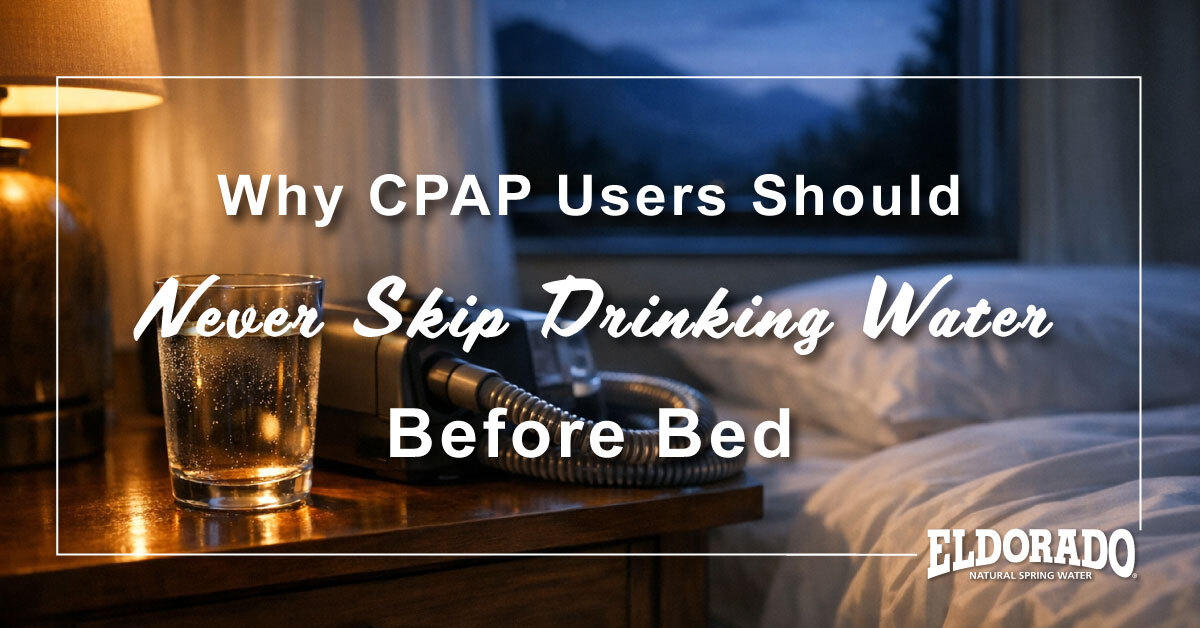
- Keep a glass of water on your nightstand for the dry-mouth wake-ups that still happen, especially in the first weeks of CPAP use or after adjusting pressure settings
- Avoid alcohol and caffeine in the hours before bed — both are diuretics that accelerate dehydration and actively undermine your CPAP therapy
Why the Quality of Your Water Matters
Not all water is the same, and for CPAP users drinking water as part of a therapeutic routine, quality is worth thinking about.
Tap water varies significantly in mineral content, chlorine levels, and pH depending on where you live. Highly chlorinated water can be irritating to an already-sensitive throat. Water with inconsistent mineral profiles doesn't hydrate as smoothly or taste as clean.
Natural spring water, sourced and bottled near the origin, carries a consistent, balanced mineral profile that supports healthy cell hydration. The trace minerals — calcium, magnesium, potassium — that occur naturally in quality spring water aren't just marketing language. They play a real role in how efficiently your body absorbs and retains water at the cellular level.
If you're building a bedtime hydration habit, building it around water you actually enjoy drinking makes the habit easier to keep. So... you should drink Eldorado Natural Spring Water every night before bed! And the best news is, we can deliver it right to your door.
A Simple Checklist for Better CPAP Nights
Good CPAP nights aren't just about the machine — they're about the whole pre-sleep routine. Here's a quick checklist:
-
Drink 8–12 oz of water 30–60 minutes before bed
-
Fill your CPAP humidifier chamber with distilled or high-quality water
-
Clean your mask and tubing regularly (bacteria thrive in warm, moist environments)
-
Keep a glass of water within arm's reach overnight
-
Hydrate consistently throughout the day — not just at night
-
Talk to your sleep specialist if dry mouth persists despite good hydration (pressure or humidity settings may need adjustment)
Our Bottom Line
Your CPAP machine is doing its job. Give it the best possible conditions to work in. Proper hydration before bed won't replace your humidifier or your pressure settings — but it will make every other element of your therapy more effective, more comfortable, and more sustainable over the long term.
People who sleep well tend to be people who've figured out that the small habits around bedtime matter as much as the equipment. Drinking a glass of good water before you put on the mask is one of the smallest, easiest habits you can add — and for CPAP users, it's one of the highest-return ones.
Sleep well. Drink well.